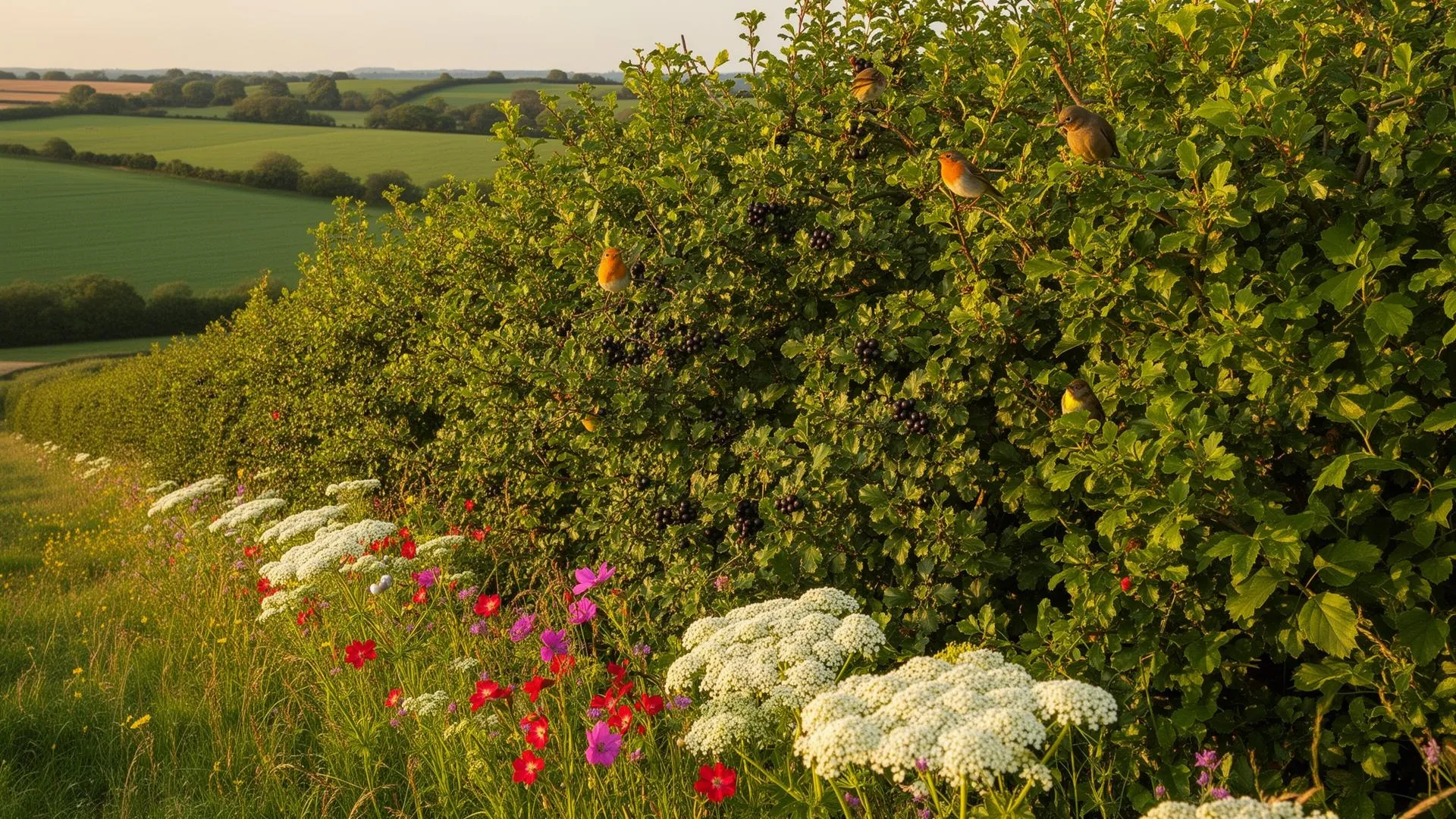
Hedgerows are the veins and arteries of the British countryside. These living field boundaries have shaped our landscape for over a thousand years, providing vital corridors for wildlife, storing carbon, preventing floods, and sheltering livestock. Yet we've lost over half of our hedgerows since 1945.
The good news? Hedgerows are one of the easiest habitats to restore. With generous government grants now available, there has never been a better time for farmers and landowners to plant new hedges and rejuvenate old ones.
Britain's Living Landscape Lines
Britain has approximately 700,000 kilometres of hedgerows, enough to stretch around the Earth 17 times. These living boundaries are overwhelmingly a human creation, planted to mark field boundaries, contain livestock, and provide wood and food. Some hedgerows date back to Anglo-Saxon times, with ancient species-rich hedges containing 7 or more woody species per 30 metres.
After World War II, government policy encouraged farmers to remove hedgerows to create larger fields for mechanised farming. Between 1945 and 1990, we lost an estimated 50% of hedgerows, amounting to roughly 190,000 km. Many remaining hedges were cut too hard, too often, or allowed to become gappy and outgrown.
Hedgerow Facts
- • 700,000 km of hedgerows remain in the UK
- • 50% of hedgerows lost since 1945
- • 2,000+ species supported by hedgerow habitats
- • 80% of woodland birds nest in hedgerows
- • Hedgerows store up to 3.5 tonnes of carbon per 100m
The Hedgerow Regulations 1997 now protect important hedgerows from removal, and agri-environment schemes increasingly reward farmers for good hedgerow management. The tide is turning.
Why Hedgerows Matter
Hedgerows punch far above their weight in terms of ecosystem services. They may occupy only a fraction of farmland, but they deliver benefits far beyond their footprint:
Wildlife Corridors
Hedgerows connect isolated habitats, allowing wildlife to move safely across the landscape. For species like dormice and hedgehogs, hedgerows are highways through otherwise hostile farmland. Bats follow hedgerow lines when hunting.
Carbon Storage
Hedgerows store carbon in their woody biomass and in the soil beneath them. A well-managed hedge can lock up 3.5 tonnes of carbon per 100 metres. UK hedgerows store an estimated 9 million tonnes of carbon in total.
Natural Flood Management
Hedgerows slow water runoff, especially when planted across slopes. Their roots improve soil structure, increasing water infiltration. On sloping farmland, hedgerows can significantly reduce flood risk downstream.
Soil Protection
Hedgerows act as windbreaks, reducing wind erosion of topsoil. They also trap sediment running off fields, keeping precious soil where it belongs and out of waterways. This improves water quality downstream.
Livestock Benefits
Thick hedges provide shelter from wind, rain, and sun. Sheltered livestock spend less energy on thermoregulation, improving weight gain and milk production. Hedges also provide browse and medicinal plants for animals.
Pollinator Highways
Hedgerows provide season-long nectar and pollen. Blackthorn flowers early (March), hawthorn in May, elder in June, and bramble through summer. This continuous food supply supports bees, butterflies, and hoverflies.
Hedgerow Wildlife
A well-managed hedgerow is one of Britain's richest wildlife habitats. From nesting birds to hibernating mammals, hedgerows support over 2,000 species:
Birds
- Yellowhammer - Red-listed farmland bird that depends on thick hedges
- Linnet - Another declining species that nests in dense thorny hedges
- Dunnock - Common hedgerow nester, often overlooked
- Bullfinch - Feeds on hedgerow berries and buds
- Song thrush - Uses hedges for nesting and shelter
- Whitethroat - Summer migrant that nests in bramble-rich hedges
Mammals
- Hedgehog - Uses hedgerows for foraging, shelter, and movement
- Dormouse - Rare species entirely dependent on connected hedgerow networks
- Harvest mouse - Builds nests in tall hedgerow vegetation
- Brown hare - Shelters in hedge bases during the day
- Bats - Many species follow hedgerow lines when commuting and hunting
Invertebrates
- Over 1,500 species of invertebrate depend on hedgerow habitats
- Bees and butterflies rely on hedgerow flowers for nectar
- Beetles and hoverflies use leaf litter at hedge bases
- Spiders build webs between branches catching flying insects
- Predatory insects provide natural pest control in adjacent crops
Planting a Hedgerow
Whether you're gapping up an old hedge or creating a brand new one, the principles are similar. Here's how to establish a thriving native hedgerow:
Step 1: Site Preparation
Clear a strip at least 1 metre wide, ideally 2 metres. Remove perennial weeds like docks, nettles, and couch grass, as these compete aggressively with establishing hedgerow plants and can smother young whips before they become established. Cultivate or clear a strip in the summer before planting. Consider your soil type and choose appropriate species.
Step 2: Species Selection
A traditional mixed hedge might contain 60-70% hawthorn for stock-proofing, with blackthorn, hazel, field maple, dog rose, elder, guelder rose, and spindle for diversity. Include holly and beech for evergreen interest. Check your local National Character Area for regionally appropriate species.
Step 3: Planting
Plant bare-root whips (60-90cm tall) in a double staggered row, 6 plants per metre. Space rows 40-50cm apart, with plants 33cm apart in each row. Plant between November and March when dormant. Don't plant too deep: keep the soil mark on the stem at soil level.
Step 4: Protection
Protect against rabbits with spiral guards or tubes. In areas with deer, use taller tubes (1.2m+). Mulch around plants with woodchip or cardboard to suppress weeds and retain moisture. Some schemes require fencing to keep livestock away during establishment.
Top Planting Tips
- • Source native plants from UK provenance nurseries
- • Keep roots moist before and during planting
- • Plant in staggered rows for density, not a single line
- • Include hedgerow trees every 6-10 metres for MOREhedges funding
- • Avoid planting under overhead power lines
Hedgerow Management
How you manage a hedgerow makes the difference between a wildlife haven and a brown skeleton. Good management encourages flowering, fruiting, and dense growth:
Cutting Regime
Cut no more than once every 2-3 years. Annual cutting prevents flowering and fruiting, starving wildlife of food. Rotational cutting lets different sections fruit in different years. Always cut between September and February to avoid the bird nesting season (it's illegal to cut during nesting).
Shape and Height
Maintain an "A-shape" profile: wider at the base than the top. This allows light to reach lower branches, keeping the base dense and stock-proof. A hedge 2-3 metres tall with a 1.5m wide base is ideal. Avoid cutting into old wood, which can kill branches.
Hedge Laying
Traditional hedge laying involves partially cutting through stems (pleaching) and bending them at 45 degrees. This stimulates new growth from the base, thickening gappy hedges. Lay hedges every 10-20 years in winter. Different regions have distinctive laying styles.
Coppicing
For very old, outgrown hedges with no base growth, consider coppicing: cutting all stems to near ground level. Most native species will resprout vigorously. This is a drastic measure, so only do sections at a time to maintain wildlife habitat continuity.
Grants & Funding
Several government and charity schemes now provide funding for hedgerow restoration. The following options are available in England, with similar schemes in Wales, Scotland, and Northern Ireland:
Sustainable Farming Incentive (SFI)
HRW1: Assess and record hedgerow condition: £5/100m
HRW2: Manage hedgerows: £13/100m
HRW3: Maintain or establish hedgerow trees: £10/100m
CHRW3: Plant new hedgerows: £24/m
MOREhedges (Woodland Trust)
Covers up to 75% of costs for 100m+ of new hedging that creates ecological links with woodland. Must include one standard tree every 6 metres. Provides trees, guards, stakes, and expert advice. One of the most generous hedgerow schemes available.
Apply for MOREhedgesCountryside Stewardship
Capital grants available for hedgerow restoration and planting. Rates for 2024/25 include £11.22/m for planting and £11.91/m for hedge laying. Check current rates as these are updated annually.
Browse CS grantsDevolved Nations
Wales: Sustainable Farming Scheme (from 2025) includes hedgerow actions
Scotland: Agri-Environment Climate Scheme offers hedgerow support
NI: Environmental Farming Scheme includes hedge management options
Stacking Payments
Many farmers combine hedgerow payments with other scheme options. For example, SFI hedgerow management can be stacked with arable margins, beetle banks, and overwintered stubbles to create farm-wide biodiversity improvements. Consult an adviser to maximise your income from environmental land management.
Ready to Restore Your Hedgerows?
Start by surveying your existing hedgerows and identifying gaps. Check your eligibility for funding schemes, and plan planting for the coming dormant season. Every metre of hedgerow restored benefits wildlife, climate, and your land.
Further Resources
Watch
How to Lay a Hedge | Traditional Hedgelaying
Expert Mike Saynor demonstrates traditional hedge laying techniques that create impenetrable, stock-proof boundaries.
How to Lay a Hedgerow | Paul Lamb Documentary
Follow hedgelayer Paul Lamb as he restores ancient field boundaries using traditional hand methods.
Managing Hedgerows for Wildlife | Devon Hedge Group
Comprehensive talk on hedgerow management for biodiversity, carbon capture, and flood prevention.
Listen
Learn More
MOREhedges Funding Scheme
Woodland TrustApply for up to 75% funding for 100m+ of new hedging connecting woodland.
Hedgerow Management Guide
HedgelinkComprehensive guidance on maintaining hedgerows for biodiversity.
Sustainable Farming Incentive: Hedgerows
DefraOfficial guidance on SFI payments for hedgerow management and creation.
People Need Hedges Campaign
CPRECampaign resources and hedgerow facts from the Countryside Charity.
Frequently Asked Questions
How much does it cost to plant a hedgerow?
Costs vary but typically range from £8-15 per metre for bare-root whips including guards and stakes. The Woodland Trust's MOREhedges scheme can cover up to 75% of costs for 100m+ of new hedging that connects woodland. The Sustainable Farming Incentive pays £10 per 100m for hedgerow management and £24 per metre for new planting. Many farmers find hedgerows become cost-neutral over time through reduced fencing costs and shelter benefits.
What are the best species for a UK hedgerow?
Traditional mixed hedgerows include hawthorn (60-70%), blackthorn, hazel, field maple, dog rose, elder, and guelder rose. For stock-proof hedges, increase hawthorn and blackthorn. For wildlife, include berry-producers like hawthorn, blackthorn, elder, and holly. Avoid laurel and privet (non-native, poor for wildlife). Check your National Character Area for locally appropriate species.
When is the best time to plant a hedgerow?
Plant bare-root hedging plants between November and March when dormant. Ideally plant in autumn (November-December) to allow roots to establish before spring growth. Avoid planting in waterlogged or frozen ground. Container-grown plants can be planted year-round but are more expensive. Prepare the ground in summer by removing competing vegetation.
How do I maintain a hedgerow for wildlife?
Cut hedges on a 2-3 year rotation rather than annually to allow berry and flower production. Cut in late winter (January-February) after birds have eaten berries. Leave some sections uncut each year. Maintain a wide base (at least 1.5m). Consider traditional hedge-laying every 10-20 years to thicken the base. Never cut during bird nesting season (March-August).
What wildlife benefits from hedgerows?
Hedgerows support over 2,000 species. They provide nesting sites for 80% of woodland birds, including yellowhammer, linnet, and dunnock. Hedgehogs, dormice, and harvest mice use hedgerows for shelter and movement corridors. Bats follow hedgerows for navigation and hunting. Over 1,500 invertebrate species depend on hedgerows, supporting the wider food chain.
Continue Reading
Stay Updated on Rewilding
Join our newsletter for the latest rewilding news, guides, and updates from The Grange Project.