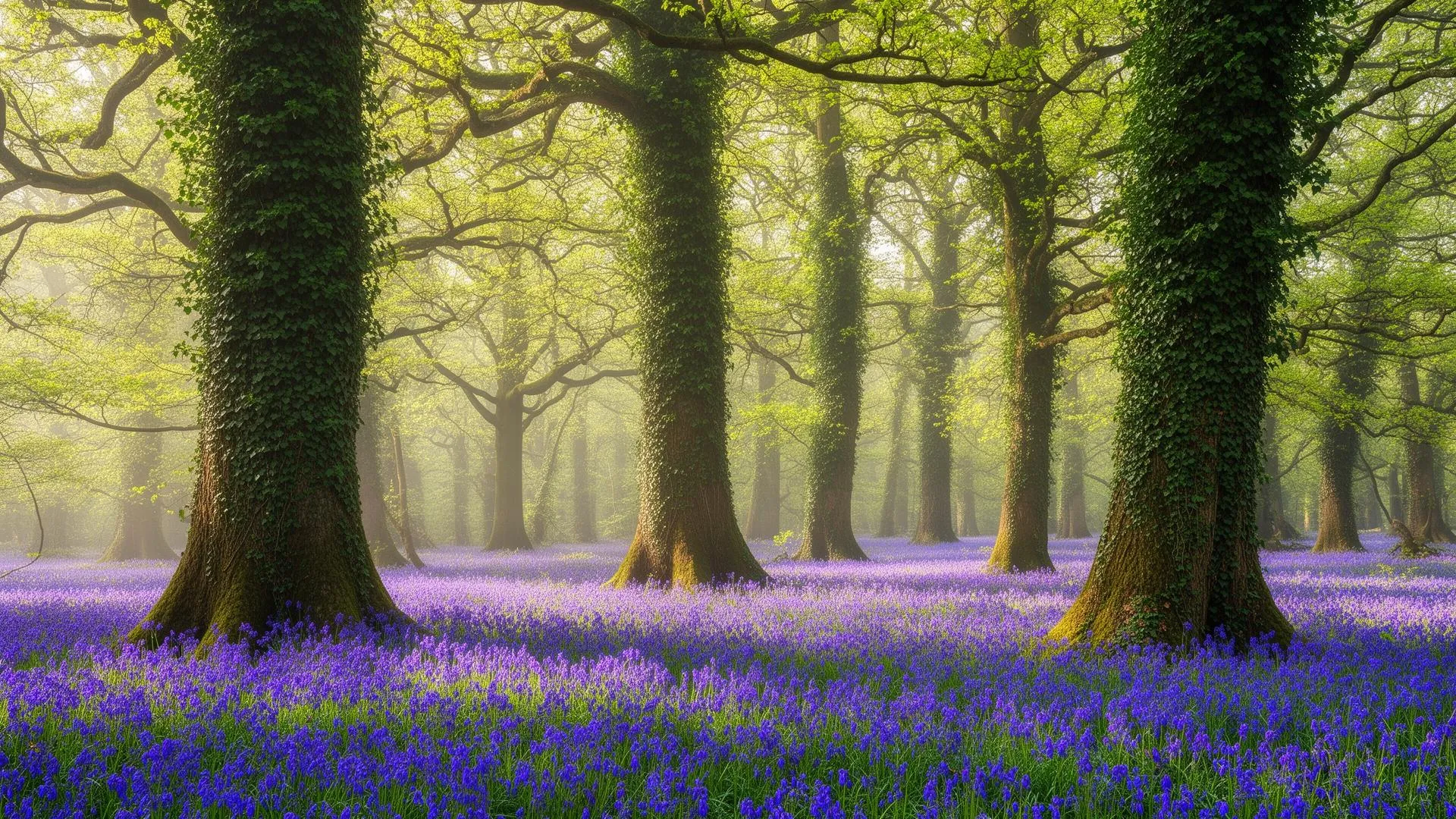
Walk into an ancient woodland in spring and you step into a world shaped by centuries. Bluebells carpet the floor in impossible purple. Gnarled oaks that were seedlings when Tudor kings ruled now host communities of lichens, mosses, and invertebrates found nowhere else. The very soil beneath your feet has been developing its fungal networks and invertebrate populations since before the Norman Conquest.
Ancient woodland covers just 2.5% of the UK, and much of what remains is degraded. But these precious sites retain ecological foundations that cannot be recreated—making restoration one of the most impactful conservation actions possible in Britain today.
What is Ancient Woodland?
Ancient woodland is land that has been continuously wooded since at least 1600 in England and Wales, or 1750 in Scotland (earlier dates chosen because reliable maps exist from these periods). These aren't necessarily old trees—many ancient woods were traditionally managed as coppice, with trees cut regularly for wood. What makes them special is continuity: the land has never been cleared for farming or development.
Ancient Semi-Natural Woodland (ASNW)
Woodland on an ancient site that retains native tree cover and characteristic ground flora. These are the most ecologically valuable sites, though many have been modified by past management or neglect. Around 350,000 hectares remain in England.
Plantations on Ancient Woodland Sites (PAWS)
Ancient woodland sites where native trees were felled and replaced with plantations, usually conifers, during the 20th century. The ancient soils often retain dormant seeds and root systems, making restoration possible. Around 200,000 hectares exist.
The distinction matters because even PAWS sites—planted with dense rows of Sitka spruce or other non-natives—can recover their ancient character if sensitively restored. The irreplaceable element is the soil and its centuries-old communities of fungi, bacteria, and invertebrates.
Identifying Ancient Woodland
How do you know if woodland is truly ancient? Ecologists look for "ancient woodland indicator species"—plants that spread so slowly they rarely colonise new sites, even over centuries.
Key Indicator Plants
- Bluebell (Hyacinthoides non-scripta) – Britain's signature woodland flower
- Wood anemone (Anemone nemorosa) – white spring flower, spreads just 6 feet per century
- Wild garlic (Ramsons) (Allium ursinum) – pungent leaves carpeting damp woods
- Dog's mercury (Mercurialis perennis) – glossy green leaves, often dominant
- Yellow archangel (Lamiastrum galeobdolon) – yellow flowers in late spring
- Pignut (Conopodium majus) – delicate white umbel flowers
- Moschatel (Adoxa moschatellina) – tiny, unique "town-hall clock" flower
- Primrose (Primula vulgaris) – pale yellow early flowers
- Herb Paris (Paris quadrifolia) – distinctive four-leaved rarity
- Sanicle (Sanicula europaea) – shade-tolerant umbellifer
The presence of several indicators together is strong evidence of ancient origin. But absence doesn't prove a wood is recent—some ancient sites have lost their ground flora to overgrazing, shading by planted conifers, or other damage.
Physical Evidence
- Coppice stools – wide, multi-stemmed bases showing centuries of cutting and regrowth
- Pollarded trees – historically cut above browsing height, often hugely spreading
- Ancient boundary banks – earthworks marking historic wood edges
- Veteran trees – ancient individuals with hollow trunks, dead branches, and diverse microhabitats
- Place names – "ley," "hurst," "shaw," "coed" (Welsh for wood), and other Anglo-Saxon and Celtic woodland terms
The Ecology of Ancient Woods
Ancient woodlands are biodiversity hotspots not because of their trees, but because of everything living with and on them. Centuries of continuous cover allow complex relationships to develop that simply cannot form in younger woodlands.
Below Ground
Ancient woodland soil is a world unto itself. Mycorrhizal fungal networks connect trees, transferring nutrients and chemical signals between individuals. These networks take decades to centuries to fully develop. The "wood wide web" helps young trees establish in shade and may even allow dying trees to bequeath resources to their neighbours.
The Deadwood Community
Dead and dying wood is crucial. Over 1,800 invertebrate species depend on decaying timber in Britain, including spectacular beetles like the stag beetle and noble chafer. Ancient woods with veteran trees and fallen deadwood support far more of these species than younger, "tidied" woodlands.
Key Wildlife
- Dormice – dependent on diverse woodland structure with hazel understorey
- Woodland butterflies – silver-washed fritillary, white admiral, purple emperor
- Hole-nesting birds – lesser spotted woodpecker, marsh tit, willow tit (all declining)
- Lichens and mosses – oceanic species on bark and rock, centuries to establish
- Specialised fungi – thousands of species from mycorrhizae to bracket fungi
The 400-Year Rule
Research suggests new woodland takes at least 400 years to develop the species assemblages found in ancient woodland, and even then may never achieve the same diversity. This is why protecting existing ancient woodland is so critical: we literally cannot recreate it within human planning horizons.
Threats and Decline
Ancient woodland has been declining for centuries—but the rate of loss accelerated dramatically in the 20th century. Understanding threats is essential for effective protection and restoration.
Conversion to Plantations
From the 1950s to 1980s, government grants encouraged felling ancient woodland and replanting with fast-growing conifers. This policy was driven by post-war timber shortages and a desire to reduce reliance on imported wood. Thousands of hectares were converted to dense, dark plantations. The ancient soil survived beneath the trees, but ground flora, invertebrates, and fungi declined severely.
Development and Infrastructure
Roads, housing, and HS2 continue to destroy ancient woodland despite its supposed protection. Between 1930 and 1985, England lost an estimated 30-40% of its ancient woodland to development and agriculture. Small fragments are particularly vulnerable because edge effects penetrate further into the core habitat, isolation prevents species dispersal between sites, and they cannot support viable populations of woodland specialists.
Neglect
Paradoxically, abandoning traditional management can harm ancient woodland. Woods once managed as coppice become dark and dense when cutting stops, shading out ground flora. Without markets for small-diameter wood, owners have little incentive to maintain traditional practices.
Deer Overgrazing
Deer populations in Britain are at their highest level for 1,000 years. Without natural predators, roe, fallow, and muntjac deer browse heavily on woodland ground flora and prevent regeneration. Many woods are slowly dying as old trees aren't replaced.
Invasive Species
Rhododendron, cherry laurel, and snowberry form dense thickets that shade out native flora. Ash dieback is killing the UK's third most common tree, opening gaps that may benefit some species but represents a massive ecological upheaval in many woods.
Restoration Approaches
Restoring ancient woodland isn't about creating new habitat—it's about removing pressures and allowing recovery. The ecological foundations are already there, preserved in the soil and dormant seed banks.
PAWS Restoration
Restoring Plantations on Ancient Woodland Sites is one of the highest-impact conservation actions in the UK. The process involves:
- Assessment – mapping surviving ground flora, native trees, and historic features
- Halo thinning – removing conifers around surviving native trees to give them light
- Gradual removal – thinning plantations over 20-30 years to avoid sudden exposure
- Natural regeneration – allowing native trees to seed in as light increases
- Enrichment planting – adding locally-sourced native trees where regeneration is slow
- Ongoing management – removing regenerating conifers, controlling deer, managing invasives
Reviving Traditional Management
Many ancient woods evolved under centuries of coppicing—regular cutting that creates a mosaic of different ages and light levels. Reviving coppice can benefit wildlife:
- Recently cut areas provide sunny glades for butterflies and ground flora
- Young growth offers dense cover for nesting birds and dormice
- Mature standards (uncut trees) provide deadwood habitat
- Regular cutting maintains hazel and other understorey shrubs
Deer Management
Without wolves or lynx, deer control falls to humans. Options include fencing (expensive but effective for small areas), culling (requires sustained effort), and natural regeneration fencing around individual trees. Without action, many woods cannot regenerate.
Sustainable Timber Production
Can ancient woodlands contribute to UK timber security? The answer is nuanced. Traditional coppice management can produce sustainable yields of small-diameter timber while maintaining biodiversity, and this approach sustained rural economies for centuries. However, clear-felling or heavy extraction of large timber from ancient woodland is rarely compatible with conservation. The key is low-intensity, continuous cover management that mimics natural disturbance rather than industrial forestry. Where timber production is a priority, new native woodland planting on appropriate sites is a better option than exploiting irreplaceable ancient sites.
UK Restoration Projects
Fingle Woods, Devon
A partnership between the Woodland Trust and National Trust is transforming 320 hectares of conifer plantation back to native woodland. Ancient ground flora including bluebells and wood anemone is recovering as conifers are removed. The project demonstrates large-scale PAWS restoration is possible.
Heartwood Forest, Hertfordshire
The largest continuous new native forest in England at 850 acres, planted to buffer and connect ancient woodland fragments. While the new planting won't become "ancient" for centuries, it creates crucial linkage for woodland species.
Sheffield Park, Sussex
The National Trust is carefully managing light levels in ancient bluebell woods to maintain conditions for the spectacular spring display. This involves selective tree work and invasive species control while protecting veteran trees.
Kielder Forest, Northumberland
Within Britain's largest commercial forest, significant areas of PAWS are being restored. The work shows how production forestry and ancient woodland restoration can coexist, with restored areas providing biodiversity corridors through the landscape.
Woodland Trust Sites Across the UK
The Woodland Trust manages hundreds of ancient woodland sites and has ambitious targets for PAWS restoration. Their work ranges from small community woods to major restoration projects, always prioritising native natural regeneration.
Visiting Ancient Woodland
Ancient woodland is found throughout Britain, often surprisingly close to towns and cities. The best time to visit is April-May when bluebells and spring flowers are at their peak.
Famous Ancient Woodlands
- Epping Forest, Essex – London's largest open space, ancient pollards and hornbeams
- Wyre Forest, Worcestershire – one of England's largest ancient woods, rich invertebrate fauna
- Sherwood Forest, Nottinghamshire – famous for its ancient oaks including the Major Oak
- Savernake Forest, Wiltshire – continuous woodland since Norman times, veteran beeches
- Coed y Brenin, Wales – extensive ancient oak woodland in Snowdonia
Visiting Responsibly
- Stick to paths to avoid trampling delicate ground flora
- Keep dogs under control, especially during bird nesting season
- Never pick wildflowers—take photographs instead
- Don't climb veteran trees or remove bark and fungi
- Report sightings of rare species to local recording schemes
Experience Ancient Woodland
The Grange Project is surrounded by ancient woodland fragments that we're working to connect and restore. Join us for guided walks, volunteer days, or simply to experience these irreplaceable habitats.
Further Resources
Watch
Restoring Ancient Woodland at Fingle Woods | Woodland Trust
Documentary on one of the UK's largest ancient woodland restoration projects on Dartmoor.
Restoring an Ancient Bluebell Wood | National Trust
Conservation of bluebell woods at Sheffield Park and Garden.
First Steps to Restoring Ancient Woodland | Woodland Trust
Practical guide featuring a landowner working to restore a four-acre ancient woodland site.
Listen
Learn More
Ancient Woodland & Veteran Trees Guidance
Natural EnglandOfficial guidance for identifying and protecting ancient woodland in England.
Ancient Woodland Restoration
Woodland TrustComprehensive guide to restoring ancient woodland including PAWS sites.
Ancient Tree Inventory
Woodland TrustInteractive map of ancient, veteran, and notable trees across the UK.
Plants & Fungi Species Guide
PlantlifeSpecies profiles for ancient woodland indicator plants.
Frequently Asked Questions
What is ancient woodland?
Ancient woodland is land that has been continuously wooded since at least 1600 in England and Wales, or 1750 in Scotland. These sites have never been cleared for agriculture or development, allowing unique ecosystems to develop over centuries. They're distinguished by their rich ground flora, veteran trees, and complex soil communities that take hundreds of years to form.
How do you identify ancient woodland?
Ancient woodland indicators include specific plants that spread slowly and rarely colonise new sites: bluebells, wood anemone, wild garlic (ramsons), dog's mercury, and yellow archangel. Other signs include old coppice stools, pollarded trees, ancient boundary banks, and diverse tree ages. The presence of multiple indicator species together is strong evidence of ancient origin.
Why is ancient woodland irreplaceable?
Ancient woodland soil takes centuries to develop its complex fungal networks, invertebrate communities, and nutrient cycling. Many woodland species disperse slowly and cannot cross open ground. Even perfectly restored new woodland takes 400+ years to develop ancient woodland characteristics. Once lost, these ecosystems cannot be recreated within human timescales.
How much ancient woodland remains in the UK?
Only about 2.5% of the UK is covered by ancient woodland—around 650,000 hectares. Of this, only about 25% is in good condition as native broadleaf. Much has been converted to plantations (Plantations on Ancient Woodland Sites, or PAWS), degraded by neglect, or damaged by invasive species. England has the least (2.4%), Scotland around 4%, and Wales approximately 6%.
What is PAWS restoration?
PAWS (Plantations on Ancient Woodland Sites) restoration involves gradually removing non-native conifers from ancient woodland sites and allowing native trees to regenerate. The ancient soils often retain dormant native seed banks and ground flora that can recover once light returns. It's one of the most effective forms of woodland restoration because the ecological foundations remain intact.
Continue Reading
Stay Updated on Rewilding
Join our newsletter for the latest rewilding news, guides, and updates from The Grange Project.