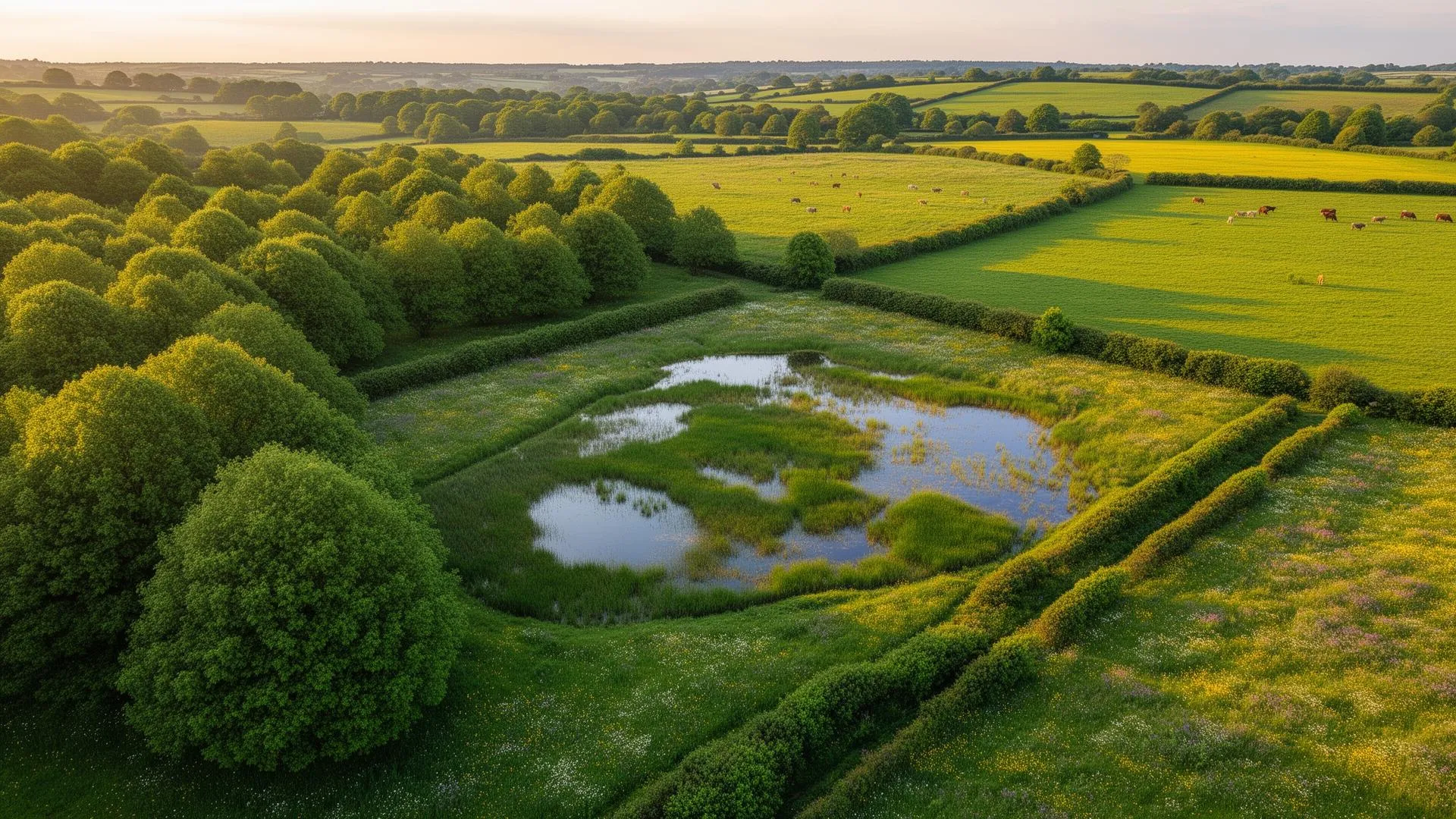
If you own land in the UK, whether a small farm, an inherited estate, or a few acres of marginal ground, you have an extraordinary opportunity. Public money now flows to landowners who restore nature rather than simply to those who own hectares. This guide explains which schemes are actually open in autumn 2026, what they pay, and how to build a durable income from nature recovery.
Rewilding is not about abandoning land. It is about working with natural processes to create thriving ecosystems that provide income through environmental payments, eco-tourism, sustainable produce, and natural capital markets. The economics have shifted, and on marginal ground many landowners now earn more from nature than they did from production.
What Changed in 2026
The funding landscape moved substantially this year. If you last looked at this in 2024 or 2025, four things are different:
- England: the old SFI closed abruptly in March 2025. A redesigned scheme, SFI26, launched with Window 1 on 30 June 2026 (closed 28 August). Window 2 opens in September 2026 and is open to all farmers and land managers.
- England: Countryside Stewardship Higher Tier is no longer invitation-only. An Expression of Interest process opened on 21 July 2026.
- Wales: the Sustainable Farming Scheme went live on 1 January 2026, replacing Glastir and BPS.
- Northern Ireland: the Environmental Farming Scheme has been replaced by Farming with Nature Transition.
Payment rates on this page were checked against GOV.UK, gov.wales, Rural Payments Scotland and DAERA in September 2026. Schemes change; always confirm current rates on the linked official pages before committing.
Assessing Your Land
Before applying for grants or planting trees, you need to understand what you have and what is possible. Every piece of land has different potential based on soil type, hydrology, existing habitats, and connection to the wider landscape.
Baseline Assessment
Walk your land and record what you have: existing hedgerows, trees, ponds, wet areas, rough grassland, and wildlife sightings. Historic maps can reveal lost features like filled-in ponds or removed hedgerows that could be restored.
Designations Check
Check for environmental designations (SSSI, SAC, SPA) on Magic Maps. These can affect what you can do but may also unlock higher-tier funding. Archaeological features and rights of way should also be mapped.
Consider your goals. Are you looking to reduce farm workload while maintaining income? Do you want to create a wildlife haven for personal satisfaction? Are you interested in eco-tourism or educational visits? Your objectives will shape which grants and approaches suit your situation.
Platform Nature: The Platform for Nature's Comeback

Unlock Recurring Revenue for Nature Restoration
Platform Nature is a digital platform that helps nature restoration projects unlock recurring, unrestricted revenue by turning land into sponsorable segments. Founded by Tom Constable (who also leads The Grange Project), the platform empowers landowners to become masters of their own destiny, less reliant on grants and uncertain credit markets.
Explore Platform NatureInteractive Land Sponsorship
Create an interactive map of your land, allowing supporters to sponsor individual segments with recurring annual payments.
Automated Engagement
Supporters receive personalised updates linked to real ecological events, from wildlife sightings to habitat changes, driving long-term renewals.
Unrestricted Funding
Unlike grants tied to specific activities, sponsorship revenue can fund leadership, back-office capacity, and long-term planning.
Platform Nature is already partnered with leading organisations including the Global Rewilding Alliance (access to 250+ rewilding projects globally), Cornwall Wildlife Trust, Radnorshire Wildlife Trust, Broughton Sanctuary, and Tir Natur (Wales's flagship rewilding project). The platform includes an industry-leading Knowledge Hub sharing best practices in digital marketing, storytelling, and community engagement.
"Sourcing unrestricted funding is a key challenge for rewilding projects around the world. Platform Nature not only promises a bold and simple solution but also achieves this in a way that cleverly enhances supporter engagement in projects."
England: The Sustainable Farming Incentive (SFI26)
SFI26 is Defra's redesigned Environmental Land Management offer for England, replacing the SFI that closed to new applications in March 2025. It pays for practical nature-friendly actions alongside food production, and it is the most accessible starting point for most English landowners.
How it works
- 71 actions to choose from, mixed and matched freely
- 3-year agreements (a few organic conversion actions run longer)
- Paid in quarterly instalments
- Minimum 3 hectares of agricultural land
- Maximum £100,000 per agreement year, one agreement per business
- Delinked payments do not disqualify you
Application windows
- Window 1: opened 30 June 2026, closed 28 August 2026. Restricted to small farms and those without an existing ELM revenue agreement.
- Window 2: opens September 2026, open to all farmers and land managers. There is no fixed closing date; it closes when the budget is allocated, with progress published at 25%, 50% and 75%.
Window 1 demand was strong, so if you are eligible for Window 2 it is worth preparing your application before it opens rather than after.
SFI26 actions most useful for rewilding
Note that action codes changed with SFI26: most now carry a leading "C" (for example the old AHL1 pollen and nectar mix is now CAHL1). These are the actions that do most rewilding work per pound.
| Action Code | Description | Payment Rate |
|---|---|---|
| SCR1 | Create scrub and open habitat mosaics | £588/ha/yr |
| SCR2 | Manage scrub and open habitat mosaics | £350/ha/yr |
| WBD4 | Arable reversion to grassland with low fertiliser input | £489/ha/yr |
| WBD1 | Manage ponds | £257/pond/yr (max 3/ha) |
| BFS6 | 6m to 12m habitat strip next to watercourses | £742/ha/yr |
| CIPM2 | Flower-rich grass margins, blocks or in-field strips | £798/ha/yr |
| CAHL1 | Pollen and nectar flower mix | £739/ha/yr |
| CAHL2 | Winter bird food on arable and horticultural land | £648/ha/yr |
| CAHL3 | Grassy field corners or blocks | £590/ha/yr |
| CIGL1 | Take grassland field corners or blocks out of management | £333/ha/yr |
| AHW3 | Beetle banks | £764/ha/yr |
| CHRW2 | Manage hedgerows | £13/100m/yr (one side) |
| CNUM3 | Legume fallow | £532/ha/yr |
| CSAM3 | Herbal leys | £224/ha/yr |
| SPM3 | Keep native breeds on grazed habitats (supplement) | £146/ha/yr |
| CLIG3 | Manage grassland with very low nutrient inputs | £151/ha/yr |
Rates verified September 2026 against the SFI26 actions list on GOV.UK. Some actions are limited-area or have compatibility restrictions.
Actions can often be stacked where they are compatible, so a field corner taken out of management (CIGL1) next to a managed hedgerow (CHRW2) with a pond (WBD1) generates several income streams from a small area. The SFI26 rules set out which combinations are permitted and which count towards the limited-area cap.
England: Higher Tier and Capital Grants
For habitat creation more ambitious than SFI can support, Countryside Stewardship Higher Tier (CSHT) is the main route. Until mid-2026 it was invitation-only. On 2 July 2026 Defra announced that it would open to direct applications, and from 21 July 2026 an Expression of Interest process went live.
Higher Tier (CSHT)
Tailored, adviser-supported agreements for priority sites: SSSIs, priority habitats, wetland and wood pasture creation, species recovery and complex landscape work. Higher payment rates and access to a wider set of capital items.
- Submit an Expression of Interest for agroforestry, woodland improvement, or a new single-farm agreement
- Natural England or Forestry Commission advice on complex sites
- Longer agreement terms than SFI
Capital Grants 2026
Three-year agreements funding the physical work: hedgerow and tree planting, fencing, water quality and natural flood management infrastructure, and assessments.
- Six groups: boundaries/trees/orchards, water quality, air quality, natural flood management, assessments, improvements
- Higher Tier capital grants and Protection and Infrastructure grants run alongside
- The 2026 round closed to applications on 1 September 2026. Watch for the 2027 offer.
Because Capital Grants operate in annual rounds that close once budget is allocated, plan capital work a year ahead. Get quotes, consents and a habitat plan ready before the window opens rather than scrambling once it does.
Wales: The Sustainable Farming Scheme
The Sustainable Farming Scheme (SFS) went live on 1 January 2026, replacing Glastir and the Basic Payment Scheme with a single five-year contract per farm. It is built in three layers: a Universal Layer that every participant follows, plus Optional and Collaborative Layers for deeper work.
Universal Layer: 12 Universal Actions
- Soil testing and soil health planning
- Habitat maintenance (UA5) and temporary habitat creation on improved land (UA6)
- Woodland maintenance (UA9)
- Integrated Pest Management
- Farm-level carbon baseline
- A tree and hedgerow planting opportunity plan
The Universal Actions were cut from 17 to 12 during consultation.
Universal Payment rates
- Whole Farm Payment: £70/ha for the first 70 hectares, then £2/ha
- Social Value Payment: £107/ha on all eligible land
- Habitat Maintenance Payment: £69/ha of habitat
- Woodland Maintenance Payment: £62/ha of woodland
- Farms of 100ha or less joining in 2026 receive a one-off £1,000 stability payment
Two rules worth knowing before you plan:
- 10% habitat on every farm. At least 10% of each farm must be actively managed as habitat. Existing semi-natural habitat counts, as does habitat established since 2022. If you fall short, UA6 lets you create temporary habitat on improved land to make up the difference. Permanent habitat created under the Optional or Collaborative Layers counts once established.
- The 10% tree cover requirement was dropped. Earlier drafts required 10% tree cover on every farm. That was removed in favour of incentivised planting via a tree and hedgerow planting opportunity plan, with generous Optional Layer support, aiming at 17,000 hectares of new trees across Wales by 2030.
The SFS also applies a progressive taper to payments above £25,000, reaching 100% for the portion above £300,000. Full detail is in the SFS 2026 scheme description.
Scotland: Agri-Environment Climate Scheme
Scotland's Agri-Environment Climate Scheme (AECS) remains the main route for funding habitat management and creation, administered through Rural Payments and Services with NatureScot input. It runs in annual application rounds.
AECS 2026 round dates
- Agri-environment applications: 23 February to 29 June 2026 (extended)
- Organics applications: 23 February to 31 July 2026
- Stand-alone irrigation lagoon applications: 23 February to 29 June 2026
Key options
- Organic farming: conversion and maintenance payments
- Wetlands and peatland: creation and restoration
- Species management: protection of vulnerable and iconic species
- Water margins: buffer strips and riparian management
- Public access: creating and managing paths and trails
The 2026 round has now closed. Watch Rural Payments Scotland for the 2027 window, which has historically opened in late February. Peatland ACTION and the Forestry Grant Scheme run separately and are worth checking alongside AECS.
Northern Ireland: Farming with Nature
The Environmental Farming Scheme (EFS) has been replaced. The Farming with Nature Transition (FwNT) Scheme, part of the wider Farming with Nature Package under Northern Ireland's Sustainable Agriculture Programme, launched in 2025 and was expanded for 2026/27.
- What it funds: habitat creation and management, protection of watercourses, and green infrastructure that connects habitats, including the capital items needed to deliver those actions.
- Year 2 window: opened 30 June 2026 and closed 31 July 2026. Late applications were not accepted.
- Delivery deadline: work must be completed by 28 February 2027, with specific dates for winter stubble, multi-species winter cover crops and flower-rich grass margins.
Full specifications are on DAERA. Year 3 is expected to follow a similar summer window, so prepare over the winter.
Woodland Creation Grants
Tree planting still carries the highest headline rates available to English landowners. The England Woodland Creation Offer (EWCO), run by the Forestry Commission, remains open and was updated during 2026.
EWCO payments (verified September 2026)
- Capital works: up to £10,200/ha, calculated as an average across the gross application area and paid against standard cost items (for example £1.72 per tree supplied and planted, £2.43 per tree shelter, £10.27/m for deer fencing).
- Annual maintenance: £400/ha per year for 15 years.
- Additional contributions: up to £12,700/ha in total, made up of nature recovery (up to £3,300/ha), recreational access (up to £3,700/ha), riparian buffers (£2,500/ha), flood risk management (£1,000/ha), woodlands close to settlements (up to £600/ha) and water quality (£500/ha).
- Low sensitivity land payment: £1,100/ha where the whole proposal sits in a low sensitivity area.
You can voluntarily reduce the £10,200/ha cap to as low as £2,500/ha. This matters if you intend to sell carbon: reducing public funding helps demonstrate additionality for the Woodland Carbon Code. EWCO does not pay for carbon itself, but the application form supports Woodland Carbon Code registration and the Woodland Carbon Guarantee.
Beyond England, Scotland's Forestry Grant Scheme, the Welsh Government Woodland Creation scheme and DAERA's Forest Expansion Scheme fill the same role. The Woodland Trust also offers MOREwoods and MOREhedges, covering up to 75% of costs for planting that creates or enhances ecological connections, and these can be stacked with other grants where rules allow.
One caution: rewilding and dense tree planting are not the same thing. Natural colonisation is eligible under EWCO (with a scarification payment of £121.85/ha to create a seed bed) and frequently produces better ecological outcomes than planting rows of protected saplings. Consider whether your site wants trees planted or simply the space and time to grow them.
Landscape Scale and Landscape Recovery
Landscape Recovery is Defra's most ambitious ELM tier, funding long-term, large-scale nature recovery across multiple holdings. The first projects from earlier rounds moved into a funded delivery phase in August 2025, backed by more than £55 million.
Status as of September 2026: a further open application round has not been confirmed. Do not build a business plan around Landscape Recovery entering a new round. Treat it as an option to watch while you pursue SFI26, Higher Tier and private finance.
The underlying logic still holds regardless of the scheme's future: nature recovers faster and more durably at scale. If you have neighbours with similar ambitions, a landscape-scale plan makes you a stronger candidate for Higher Tier, for private investment, and for whatever collaborative funding comes next. Wales's Collaborative Layer under the SFS is built on the same principle.
Signs you should be thinking at landscape scale
- You have 100+ hectares, or neighbours willing to collaborate
- You are committed to long-term (20+ year) nature recovery
- Your land connects to, or could connect to, existing designated sites
- You are willing to run biodiversity monitoring and reporting
- Your project has a coherent hydrological or habitat story across boundaries
Diversifying Income from Rewilded Land
Government grants are the floor, not the ceiling. The most resilient rewilding businesses combine public payments with several independent income streams, so a scheme closing abruptly (as SFI did in 2025) does not sink the project.
Eco-Tourism & Stays
Safari experiences, wildlife hides, glamping, and cabin stays attract visitors willing to pay premium prices for authentic nature experiences. This is typically the fastest-maturing income stream on a rewilding holding.
Carbon Credits
Woodland creation and peatland restoration can generate verified carbon units through the Woodland Carbon Code and Peatland Code. Additionality rules mean you may need to reduce or forgo some public funding to sell them, so model both routes before choosing.
Conservation Grazing
Native breed cattle, ponies, and pigs can manage habitats while producing premium meat, and SFI26 pays supplements for keeping native breeds on grazed habitats. Pasture-fed, rare-breed products command high prices through direct sales.
Educational Visits
Schools, universities, and corporate groups pay for guided visits, team-building days, and educational programmes. This builds community connections and supports the next generation of conservationists.
Biodiversity Net Gain: a narrower opportunity
BNG remains mandatory for most development in England, requiring a 10% biodiversity uplift, and developers who cannot deliver it on site buy off-site units from landowners. But the market changed on 6 August 2026, when new exemptions came into force removing developments of 0.2 hectares or under and most short-term permissions (planning permission of five years or less) from the requirement.
Unit prices vary enormously by habitat type: roughly £23,000 for common hedgerow units up to over £200,000 for priority river habitats. Prices for common habitats such as other neutral grassland have softened since late 2025. BNG agreements also tie the land up for 30 years. It can be an excellent fit for a specific parcel with high-value habitat potential near development pressure, and a poor fit almost everywhere else. Get independent advice before committing land.
Inspiring UK Case Studies
Knepp Estate, West Sussex
1,400 hectares | Converted from intensive dairy and arable
The most famous UK rewilding project. Charlie Burrell and Isabella Tree transformed a financially failing farm into a thriving wildland. Now home to turtle doves, nightingales, purple emperor butterflies and free-roaming longhorn cattle, Tamworth pigs and Exmoor ponies. Rewilding Britain's case study puts Knepp's nature-based tourism business at around £800,000 turnover at a 22% margin, alongside pasture-fed meat sales and environmental payments.
The Grange Project, Monmouthshire
100 hectares | Mixed rewilding and regenerative farming
Our own project demonstrates how rewilding works alongside community engagement. Wetland restoration, hedgerow planting, and conservation grazing with native cattle and Tamworth pigs. Income from cabin stays, events, and environmental payments. Book a stay to experience it yourself.
Wild Ken Hill, Norfolk
1,800 hectares | Featured in BBC Springwatch
A three-part model that keeps productive regenerative arable alongside traditional conservation and a rewilded core with beavers and free-roaming grazers. A useful template for landowners who cannot or do not want to rewild the whole holding, and proof that partial rewilding can still deliver landscape-scale results.
Rewilding Britain's Rewilding Network passed 1,000 members in December 2024 and has kept growing since. It remains the best place to find landowners doing this a few years ahead of you, and to avoid repeating their expensive mistakes.
Your First Steps
Ready to begin? Here is a practical sequence to get your rewilding project started:
- Walk your land with fresh eyes. Map existing habitats, wet areas, old hedgerows, and wildlife corridors. Take photos and notes, and record a proper baseline before you change anything. You cannot prove uplift you did not measure.
- Check designations and constraints on Magic Maps (England), Lle (Wales), NatureScot's SiteLink (Scotland) or DAERA's map viewer. Understand what constraints and opportunities exist.
- Identify your nation's live scheme. England: prepare for SFI26 Window 2 and submit a Higher Tier Expression of Interest. Wales: get your SFS contract and 10% habitat position right. Scotland: prepare now for the 2027 AECS window. Northern Ireland: prepare for the next FwNT window.
- Contact Platform Nature or another rewilding consultant for a feasibility assessment. Professional guidance significantly improves grant success rates, and independent revenue reduces your exposure to scheme changes.
- Start with the cheap interventions. Stop fertiliser, reduce cutting and grazing pressure, let scrub come, and open up watercourses. These cost little, need no permission, and produce the fastest ecological response.
- Connect with the Rewilding Network to meet other landowners, share experiences, and learn from those ahead of you on the journey.
- Visit rewilding projects like The Grange, Knepp, or Wild Ken Hill. Seeing rewilding in action is the best inspiration and education.
See Rewilding in Action
Visit The Grange Project to experience rewilding first-hand. Stay in our off-grid cabin, walk the restored wetlands, and meet our conservation grazing animals.
Further Resources
Watch
Knepp Estate: Britain's Pioneering Rewilding Project
See how the Knepp Estate transformed from intensive farming to a thriving rewilding success, now generating significant income from nature-based enterprise.
Inside the Rewilding Farm Saving Britain's Lost Wildlife
Follow Coombeshead Farm's journey from conventional farming to rewilding, demonstrating the transition process for landowners.
England Woodland Creation Offer Explained
A technical guide to the government's primary woodland grant scheme, including application process and payment rates.
Listen
Learn More
Platform Nature
Platform NatureDigital platform helping nature projects unlock recurring revenue through interactive land sponsorship maps.
SFI26: Scheme Information & Full Action List
GOV.UKOfficial rules, eligibility and the full list of 71 SFI26 actions with current payment rates.
Countryside Stewardship Higher Tier: Express Your Interest
GOV.UKThe Expression of Interest route that replaced the invitation-only entry to Higher Tier in July 2026.
England Woodland Creation Offer
GOV.UKUp to £10,200/ha for woodland creation, plus up to £12,700/ha in additional contributions.
Sustainable Farming Scheme 2026 (Wales)
Welsh GovernmentFull scheme description for the SFS, live in Wales since 1 January 2026.
Farming with Nature Transition Scheme (Northern Ireland)
DAERAThe scheme that replaced the Environmental Farming Scheme in Northern Ireland.
Rewilding Britain: Rewilding Network
Rewilding BritainJoin the Rewilding Network for support, advice, and connection with other rewilding landowners.
Frequently Asked Questions
How much land do I need for rewilding?
There is no minimum size for rewilding itself. A 1-hectare field can support a wildflower meadow and a pond, while larger holdings can introduce grazing animals. Funding schemes do set thresholds though: in England, SFI26 requires at least 3 hectares of agricultural land. Even farm corners and field margins count ecologically. The key is connecting your land to the wider landscape.
Can I still get farm payments if I rewild? What replaced the Basic Payment Scheme?
In England, BPS has been replaced by delinked payments, which are being phased out, and by Environmental Land Management schemes. Receiving delinked payments does not stop you applying for the Sustainable Farming Incentive. SFI26 agreements are capped at £100,000 per agreement year, so nature-friendly actions can now be a substantial part of farm income rather than a sideline. Wales, Scotland and Northern Ireland run their own schemes.
How long before I see results from rewilding?
Wildlife responds quickly to reduced management. You may see increased bird activity within months, wildflowers appearing in the first spring after stopping fertiliser use, and small mammals within 1-2 years. Woodland establishment takes 10-20 years, but scrub and hedgerows provide habitat much sooner.
Do I need planning permission to rewild my land?
Most rewilding activities do not require planning permission. Reducing grazing, creating ponds, planting hedgerows, and allowing natural regeneration are generally permitted. However, large-scale tree planting, building hides or structures, or significant earthworks may need consent, and woodland creation usually needs an Environmental Impact Assessment screening from the Forestry Commission or the equivalent body. Always check with your local planning authority.
Can I still farm while rewilding part of my land?
Absolutely. Many successful rewilding projects operate alongside productive farming. Conservation grazing, silvo-pasture, and agroforestry blend production with nature recovery. Strategic rewilding of marginal land, field corners, and boundaries can enhance the whole farm ecosystem while maintaining core agricultural operations.
Is Biodiversity Net Gain still an opportunity for landowners?
Yes, but the market has narrowed. BNG remains mandatory for most development in England, though exemptions that came into force on 6 August 2026 removed sites of 0.2 hectares or under and most short-term permissions from the requirement. Prices vary hugely by habitat type, from roughly £23,000 for common hedgerow units to over £200,000 for priority river habitats, and prices for common habitats have softened. Treat BNG as one possible income stream rather than a guaranteed one.
Continue Reading
Buying Land for Rewilding
Complete guide to purchasing land for nature restoration in the UK.
Hedgerow Restoration
Grants and guidance for restoring this vital farm habitat.
Wildflower Meadows
How to create and manage species-rich grasslands on your land.
Wetlands & Rivers
Restoring water features for flood management and wildlife.
Stay Updated on Rewilding
Join our newsletter for the latest rewilding news, guides, and updates from The Grange Project.