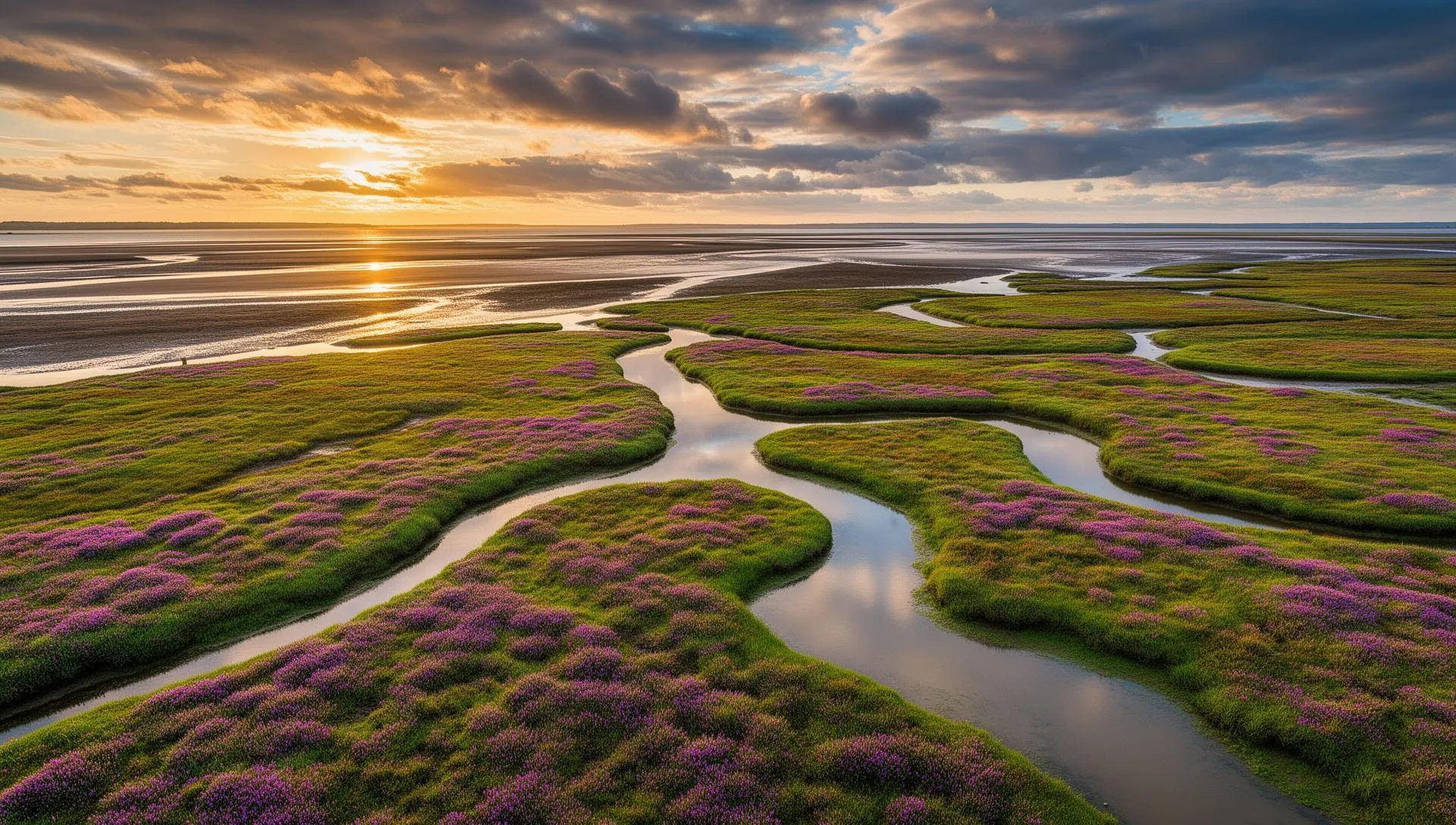
Stand on the edge of a salt marsh at high tide and watch the sea reclaim its ancient territory. Silvery water threads through channels carved over millennia, submerging beds of samphire and sea aster. Waders probe the mud. Somewhere, a curlew calls. This is one of Britain's most productive ecosystems, and one we're only now learning to value.
For centuries, we drained salt marshes for farmland, built sea walls, and turned our backs on the coast. Now, facing rising seas and a climate emergency, we're realising these habitats hold one of the keys to adaptation.
What is Coastal Rewilding?
Coastal rewilding means restoring natural processes to shorelines: allowing salt marshes to form, reconnecting estuaries with their floodplains, and removing or setting back hard defences that have separated land from sea.
Salt Marsh
Intertidal areas vegetated with salt-tolerant plants. Created where sediment accumulates in sheltered coastal waters. The UK has roughly 45,000 hectares, but lost over 100 km² in the 20th century to land reclamation.
Coastal Grazing Marsh
Low-lying pasture behind sea walls, typically grazed by cattle or sheep. Rich in drainage ditches and pools. Important for breeding waders and wintering wildfowl. Often the first habitat recreated during managed realignment.
Coastal rewilding recognises that fighting the sea is increasingly futile. Instead, working with natural processes creates habitats that provide flood defence, carbon storage, fisheries nurseries, and wildlife corridors—all while adapting to climate change.
The Salt Marsh Ecosystem
Salt marshes are among the harshest environments for plants, flooded twice daily with salt water, baked by sun, scoured by storms. Yet specialised species thrive here, creating one of Britain's most productive habitats.
Zonation
Salt marshes show distinct bands of vegetation based on how often they're flooded:
- Pioneer zone – glasswort (samphire) and cordgrass colonise bare mud
- Lower marsh – sea aster, annual sea-blite, common saltmarsh-grass
- Mid marsh – sea lavender, sea purslane, thrift (sea pink)
- Upper marsh – sea wormwood, red fescue grass, transitioning to dry land
Wildlife
The productivity of salt marshes attracts an abundance of life:
- Wading birds – redshank (the "sentinel of the marsh"), curlew, oystercatcher, dunlin
- Wildfowl – brent goose, wigeon, teal, shelduck graze marsh vegetation in winter
- Fish – bass, mullet, flounder use creeks as nurseries; 60% of commercial species depend on estuaries
- Invertebrates – the nationally scarce fisher spider, various crabs, shrimps, and molluscs
- Plants – specialists like golden samphire, sea heath, and the endangered least lettuce
Ecosystem Services
Flood defence: A 80-metre width of salt marsh can reduce wave heights by over 60%
Fisheries: Estimated value of £1.5 billion annually to UK commercial fisheries
Water quality: Marshes filter pollutants and excess nutrients from rivers
Carbon: Up to 40 times more carbon per hectare than woodland
Blue Carbon & Climate
"Blue carbon" refers to carbon captured and stored by coastal and marine ecosystems. Salt marshes, seagrass beds, and mangroves (in tropical regions) are the planet's most efficient carbon sinks, and restoring them is increasingly recognised as a climate solution.
Carbon Champions
UK salt marshes accumulate the equivalent of around 700,000 tonnes of CO₂ annually, a significant contribution to Britain's natural carbon budget. When salt marsh is destroyed, stored carbon is released. Conversely, creating new salt marsh through managed realignment begins capturing carbon immediately. New marshes can accumulate carbon at rates of 0.5 to 2 tonnes per hectare annually.
How It Works
Salt marsh plants capture CO₂ through photosynthesis like all plants. But unlike forests, the carbon doesn't get released when vegetation dies. Instead, it's buried in waterlogged, oxygen-free sediments where decomposition is slow. Over centuries, thick layers of carbon-rich peat build up.
Climate change makes coastal habitats even more valuable. As seas rise, salt marshes can migrate landward if given space, continuously storing carbon while providing natural flood defence. Hard sea walls prevent this migration, causing "coastal squeeze" that destroys marshes from both sides.
Threats to Coastal Habitats
England has lost an estimated 85% of its salt marsh since 1860. The pace of destruction accelerated dramatically in the 20th century, and threats continue today.
Land Reclamation
Building sea walls and draining marshes for farmland has been practised since Roman times. The Fens, Romney Marsh, and countless estuaries were once vast wetlands. Some reclaimed land now lies below sea level, requiring constant pumping.
Coastal Squeeze
Salt marshes naturally migrate landward as seas rise. Hard sea walls prevent this, trapping marshes between rising water and fixed defences. An estimated 100 hectares of salt marsh are lost each year in southeast England alone to coastal squeeze.
Development & Pollution
Ports, industry, and housing have destroyed coastal habitats around major estuaries. Pollution from agricultural runoff, sewage, and industrial discharge continues to degrade water quality and harm wildlife in surviving marshes.
Invasive Species
Common cord-grass (Spartina anglica), an invasive hybrid, spreads rapidly and can outcompete native salt marsh plants. While it does provide some ecosystem services, dense monocultures reduce biodiversity and change marsh character.
Restoration Techniques
Coastal restoration ranges from simple non-intervention to major engineering projects. The approach depends on site conditions, funding, and the balance between nature conservation and existing land uses.
Managed Realignment
The most ambitious technique involves deliberately breaching or removing sea defences to allow tidal flooding of former farmland. This typically follows a careful process:
- Site assessment – evaluate sediment conditions, tidal range, and ecological potential
- Landowner engagement – often requires purchasing or compensating agricultural land
- New defence construction – build a setback defence to protect remaining land
- Breach creation – carefully controlled breaching of old sea wall
- Monitoring – track sediment accretion, vegetation colonisation, and wildlife
Regulated Tidal Exchange
Where full realignment isn't possible, controlled structures can allow limited tidal flooding. Sluices, tide gates, or breaches with restricted openings create brackish habitats that benefit wildlife while maintaining some flood protection.
Saltmarsh Restoration
Degraded existing marshes can be restored through:
- Grazing management – light grazing maintains diversity; removing or reducing grazing helps recovery
- Creek restoration – reopening blocked channels improves tidal flushing
- Invasive species control – managing Spartina allows native vegetation to recover
- Sediment recharge – adding dredged material can raise eroding marsh surfaces
UK Restoration Projects
Wallasea Island, Essex
The RSPB's Wild Coast Project transformed 670 hectares of low-lying farmland into one of Europe's largest coastal wetland restoration sites. Using 3 million tonnes of soil excavated from London's Crossrail tunnels, the project created mudflats, salt marsh, saline lagoons, and grazing marsh. It now supports avocets, spoonbills, and marsh harriers.
Steart Marshes, Somerset
The Environment Agency and Wildfowl & Wetlands Trust created 250 hectares of new inter-tidal habitat by breaching sea walls on the Severn Estuary. Completed in 2014, Steart Marshes now hosts thousands of wintering birds and demonstrates how managed realignment can work alongside continuing agriculture.
Medmerry, West Sussex
The largest open coast managed realignment in Europe (2013), Medmerry created 183 hectares of intertidal habitat while providing improved flood protection to over 300 homes. The site is now a nature reserve with significant populations of waders and wildfowl.
Alkborough Flats, Humber Estuary
This managed realignment scheme on the Humber created 440 hectares of inter-tidal habitat in 2006. Studies show it now stores significant flood water during tidal surges, demonstrating the "room for the river" concept that's increasingly applied to coasts.
Cwm Ivy Marsh, Gower
The National Trust is allowing natural coastal processes to reshape this Welsh site, creating a mosaic of salt marsh, dune, and freshwater habitats. It demonstrates how "do nothing" approaches can be as valuable as active intervention.
Visiting Salt Marshes
Salt marshes are accessible year-round, though spring and autumn migrations bring the greatest bird spectacles. Always check tide times, as the character of a marsh transforms completely between high and low water.
Top Salt Marsh Sites
- North Norfolk Coast – Titchwell, Holkham, Blakeney Point, among Britain's finest coastal wetlands
- Morecambe Bay, Lancashire – vast expanse of salt marsh and mudflats, famous for wintering waders
- Dee Estuary, Wales/England – internationally important for wintering birds, accessible reserves at Burton Mere
- Solway Firth, Scotland – wild and remote salt marshes on both Scottish and English shores
- The Wash, Lincolnshire – Britain's largest estuary with extensive salt marsh and mudflats
Visiting Safely
- Check tide times, as incoming tides can cut you off quickly on flat marshes
- Stick to marked paths where possible; soft mud can be treacherous
- Use binoculars to observe birds from a distance to avoid disturbance
- Wear waterproof boots, as salt marsh vegetation often conceals channels
- Never attempt to cross unmarked mud or sand without local knowledge
Explore Coastal Wales
While The Grange Project focuses on inland rewilding, the Welsh coastline offers spectacular salt marsh and coastal habitats within easy reach. Stay with us and explore the nearby Gwent Levels, Severn Estuary, or the wild Pembrokeshire coast.
Further Resources
Watch
Something Strange is Happening to UK Coasts | WWT
Exploring how managed realignment at Steart Marshes and other sites is transforming Britain's coastline.
Landscapes of the Future: Helping Wetlands Withstand Climate Crisis | RSPB
How the Wild Coast project and South Essex Marshes are creating resilient coastal habitats.
Medmerry Managed Realignment Scheme | Environment Agency
Europe's largest open coast realignment project protecting communities and creating wildlife habitat.
Listen
Learn More
Marine Conservation Zone Designations
Natural EnglandOfficial guidance on marine protected areas including salt marsh habitats.
Blue Carbon: Wetlands for Climate
Wildfowl & Wetlands TrustInteractive feature on the climate benefits of coastal wetland restoration.
Coastal Wildlife Reserves
RSPBRSPB's coastal habitat acquisition and management for birds and wildlife.
Shoreline Management Plans
Environment AgencyGuidance on coastal management approaches including managed realignment.
Frequently Asked Questions
What is a salt marsh?
Salt marshes are coastal wetlands flooded regularly by tides. They form in sheltered areas where sediment accumulates, creating mudflats colonised by salt-tolerant plants like cordgrass, sea lavender, and samphire. The UK has approximately 45,000 hectares of salt marsh, concentrated around estuaries and behind coastal barriers.
Why are salt marshes important for climate change?
Salt marshes are 'blue carbon' ecosystems that capture carbon dioxide up to 40 times faster per hectare than tropical rainforests. UK salt marshes accumulate the equivalent of around 700,000 tonnes of CO₂ annually. They also provide natural flood defence, with healthy marshes absorbing wave energy and reducing coastal erosion far more cost-effectively than hard engineering.
What is managed realignment?
Managed realignment is a coastal management strategy where sea defences are deliberately breached or set back to allow the sea to flood previously reclaimed land, creating new salt marsh. This provides natural flood defence, carbon storage, and wildlife habitat. Major UK projects include Steart Marshes (Somerset) and Wallasea Island (Essex).
What wildlife lives in salt marshes?
Salt marshes support specialist plants like glasswort, sea aster, and sea purslane. They're vital for wading birds including redshank, curlew, and oystercatcher. Fish and invertebrates use marshes as nursery grounds, with 60% of commercial fish species depending on coastal wetlands at some life stage. Rare species include the fisher spider and sea hog-louse.
Can you forage in salt marshes?
Yes, salt marshes offer excellent foraging for samphire (marsh samphire/glasswort), sea purslane, sea aster, and sea beet. Always forage sustainably, taking small amounts and avoiding disturbing wildlife. Check local regulations as some marshes are protected nature reserves. The best season is typically June to August for most edible plants.
Continue Reading
Stay Updated on Rewilding
Join our newsletter for the latest rewilding news, guides, and updates from The Grange Project.