Overview
Tir Natur was established in 2022 by a small group of Welsh citizens concerned about the state of nature in Wales. It is a Charitable Incorporated Organisation, charity number 1199300. Its stated vision is a Wales where wild nature and communities thrive together, where ecosystems are fully restored and people rediscover their place within them.
In February 2026 the charity secured 1,195 acres at Cwm Doethie in the Elenydd, part of the Cambrian Mountains in Ceredigion. It describes this as the largest rewilding site in Wales, and makes the sharper point that until then there were no large-scale rewilding sites in Wales at all. The naturalist Iolo Williams is its ambassador. Its chair is Tasha Reilly, a Carmarthenshire farmer and former plant scientist at Kew.
The charity commits at least 90 per cent of donations directly to buying or leasing land, and says all its land projects stay open access. It works bilingually, with Welsh treated as an essential skill for its posts.
The Land at Cwm Doethie
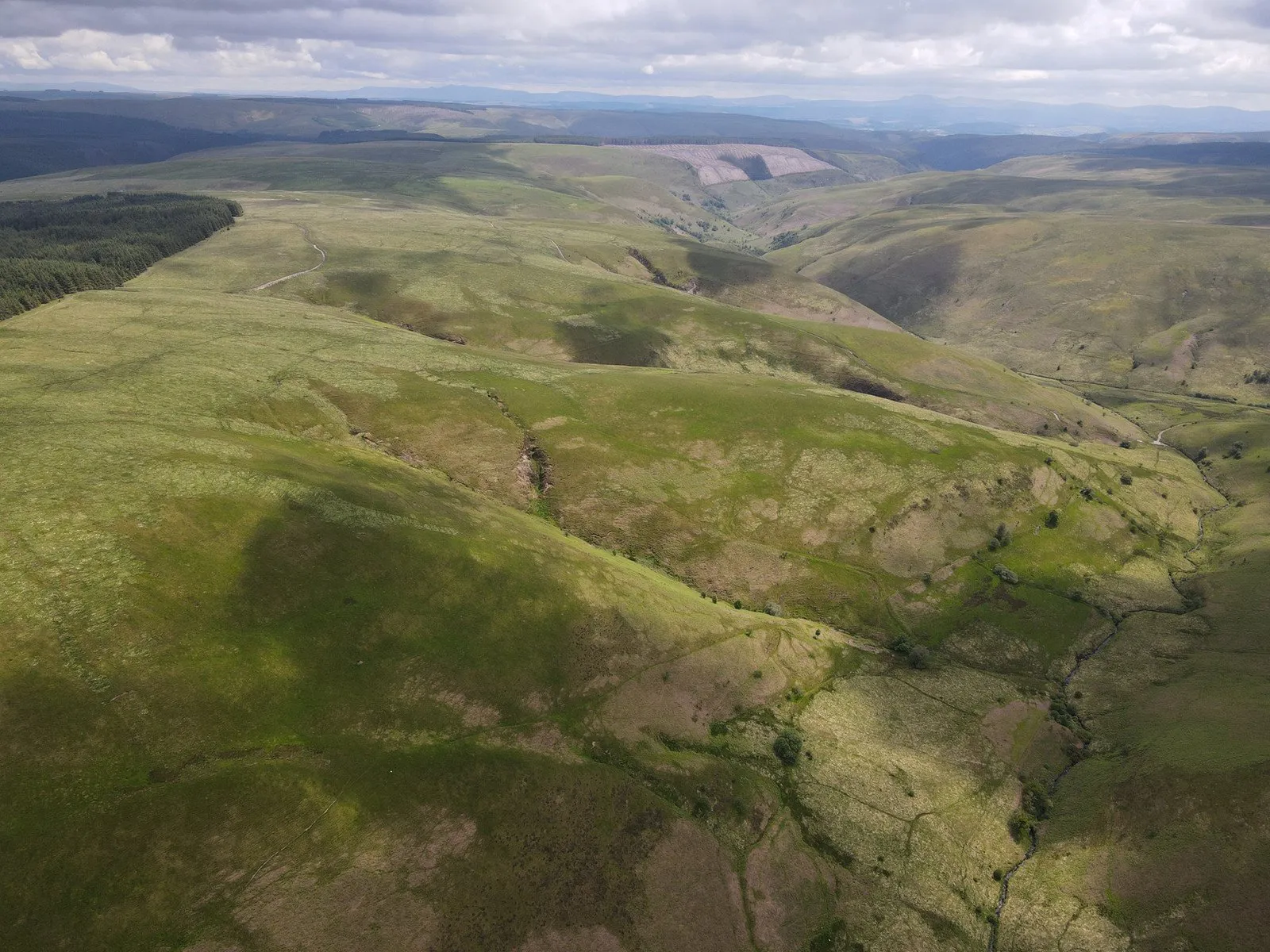
The site sits roughly nine miles from Tregaron and thirteen from Rhandirmwyn, and is one continuous block with no roads or internal barriers. It falls into three parts. The upper Doethie Fach and its peatlands, 580 acres, where a thousand-year-old blanket bog covers the plateau. The Camddwr, 367 acres of grassland and bracken with largely treeless river banks, holding water voles, otters and grey wagtails. And Cwm Doethie itself, 252 acres of ancient oak woodland with lichen assemblages that mark it as temperate rainforest, with rowan and birch regenerating.
There are two rivers totalling around 9 km, 160 acres of degraded peatland ready for rewetting, and 55 recorded historic landmarks and buildings, from Bronze Age cairns to a medieval cruck hall.
The land carries serious designations. It lies within the Cwm Doethie and Mynydd Mallaen SSSI and SAC, the latter covering 4,121 hectares and designated for old sessile oak woodland, and within the Elenydd and Mallaen Special Protection Area, 30,022 hectares classified for red kite, peregrine and merlin.
One thing it is not, despite how often the Cambrian Mountains are described: it is not a National Landscape. The Cambrian Mountains have never been designated. A National Park proposal was rejected in 1973 and a petition for protected landscape status was debated and failed in 2022.
How the Land Was Bought
The purchase price was £2.2 million. Tir Natur completed it using a philanthropic bridging loan, which secured the land while fundraising continued. Named funders include the Moondance Foundation and the Garfield Weston Foundation, alongside private donors. The vendors continue to live in the farmhouse and farm productive land nearby.
A public appeal is running alongside it, and the charity passed £100,000 in public donations in April 2026, two months ahead of its own schedule. This matters for anyone reading the story as a finished success: the land is secured, the money is not yet fully raised.
Grazing and Restoration
Cattle returned to the site in August 2026, through a partnership with a local farmer who knows the ground. Welsh mountain ponies are to follow, and ancient breed pigs later. Stocking is roughly 0.03 livestock units per hectare, a fraction of commercial density, and is adjusted as the land responds.
The choice of animals is not sentimental. The land is dominated by purple moor grass, which sheep will not eat, and bracken, which is toxic to them. Its grazing value was assessed as poor, and commercial forestry is ruled out by the SSSI designation. Hardy cattle, ponies and pigs act as proxies for the large herbivores that shaped these uplands, creating a mosaic rather than a uniform sward.
The restoration work is mostly a matter of undoing drainage. Rewetting the 160 acres of damaged peat should return moss, cotton grass and sundews, with snipe breeding. Oak and alder are expected to spread along the rivers into Celtic rainforest patches, and heather and bilberry to return on the valley tops. The charity gives a five to ten year horizon for visible change, and sets no species targets.
Species and the Long View
Nothing has been reintroduced at Cwm Doethie and nothing is currently planned there. Tir Natur supports reintroduction where it is feasible and appropriate, and names golden eagles and beavers as national aspirations for Wales rather than commitments for this site. It says any reintroduction would follow extensive feasibility work and local community support.
What it hopes for at Cwm Doethie is recolonisation rather than release: pine marten, red squirrel, otter and water vole finding their own way back as the habitat improves. The Doethie is a tributary of the Tywi, so what happens on these slopes reaches a river system known for its sea trout and salmon.
The Farming Question
The project has not been universally welcomed. The president of the Farmers' Union of Wales raised concerns about its scale, the transparency of its management and the implications for food production. The Game and Wildlife Conservation Trust argued that nature reserves alone cannot reverse biodiversity decline without supporting farmer-led transitions.
That reaction has a history behind it. The Summit to Sea project further north collapsed in the face of farmer opposition and accusations of eco-colonialism, and any rewilding project in a Welsh farming county is read against it. Tir Natur's decision to graze through a local farmer, to work bilingually and to keep the land open is a direct answer to that, and worth judging on whether it holds over time.
How to Support Tir Natur
Sponsor a Square gives a 3 metre by 3 metre square for £50 with a certificate and a what3words location. Community Founding Memberships are £5,000 or £10,000. There is regular giving, legacy giving, corporate partnership and a volunteer programme that includes ecological surveying, with more than 35 active volunteers. The land is already open access. Visit tirnatur.cymru to donate or volunteer.
Further Resources
Watch
Ep. 050: The Future of Rewilding in Cymru (Wales), Tir Natur
Our own Wilder Podcast conversation about Tir Natur and the future of rewilding in Wales.
Learn More
The land at Cwm Doethie
Tir NaturThe charity's own description of the site, block by block.
Tir Natur land appeal
CrowdfunderThe live public appeal towards the cost of the land.
Welsh nature charity to rewild Ceredigion uplands
Farmers WeeklyIndependent coverage including stocking density and the farming response.
Cwm Doethie and Mynydd Mallaen SAC
JNCCThe official designation record for the protected site.
Frequently Asked Questions
Where is Tir Natur's rewilding site?
At Cwm Doethie in the Elenydd, part of the Cambrian Mountains in Ceredigion, mid Wales, roughly nine miles from Tregaron. It covers 1,195 acres, about 483 hectares, in one continuous block with no roads or internal barriers.
Can I visit Cwm Doethie?
Yes. Tir Natur says the land is already open access and that will not change. It plans to open more paths and run tours and activity days, and it runs volunteer days including ecological surveying.
How much did the land cost and who paid for it?
£2.2 million. Tir Natur completed the purchase with a philanthropic bridging loan and is still fundraising to repay it. Named funders include the Moondance Foundation and the Garfield Weston Foundation, alongside private donors and a public appeal.
Is farming stopping on the land?
No, but it changes. Hardy cattle returned in August 2026 through a partnership with a local farmer, at roughly 0.03 livestock units per hectare. Ponies and later pigs will follow. The aim is naturalistic grazing that builds a habitat mosaic rather than production, on land assessed as poor for sheep because it is dominated by purple moor grass and bracken.
Continue Reading
Stay Updated on Rewilding
Join our newsletter for the latest rewilding news, guides, and updates from The Grange Project.