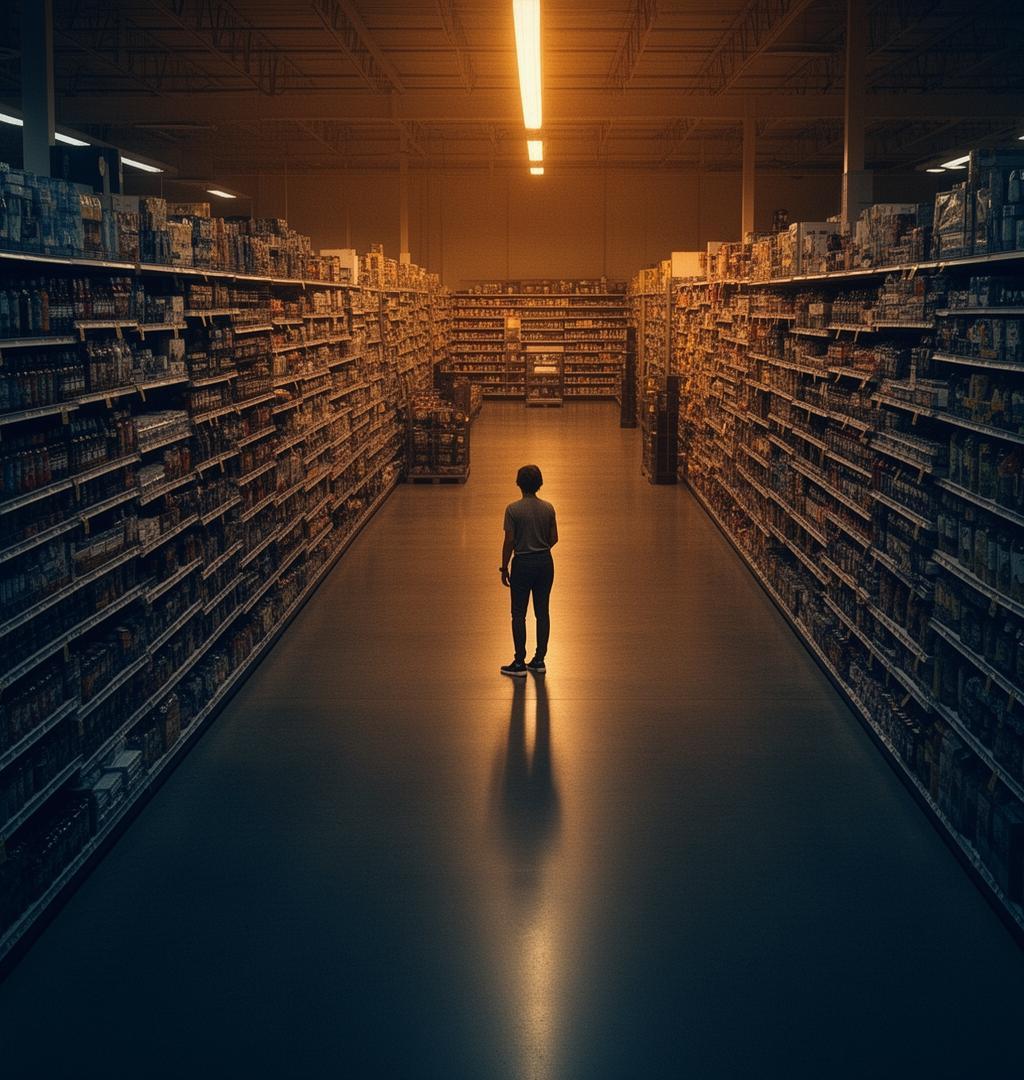
Every Friday evening, somewhere in Britain, a parent stands in a supermarket aisle at seven o'clock trying to do the right thing.
Organic, or not? Local, or not? Plastic-free, or not? Does grass-fed matter more than air miles, or the other way round? Is that 'natural' label actually meaningful, or marketing? Is there time to cook from scratch tomorrow, or does the ultra-processed ready meal have to win again?
This is a scene Sue Pritchard, Chief Executive of the Food, Farming and Countryside Commission, described to us on the Wilder Podcast. Her conclusion after seven years of working on UK food policy is one we found uncomfortable, because it ran against our instincts. But it is hard to argue with.
You cannot shop your way out of this.
"I'm often more cautious than many about talking about what consumers can do by shopping differently, because I think the issues are too big, too structural, too systemic to be solved by a person racing around the supermarket at seven o'clock on a wet Friday night trying to work out how they're going to feed their family for the week."
Sue Pritchard
The trap of individual action
The instinct that every pound you spend is a vote is a good instinct. It is also, on its own, not enough. For three reasons.
The first is that the system was not built for conscious consumers. It was built for efficient supply chains, predictable margins, and shelf life. Most of its costs are invisible at the till. Even when you can see a label telling you something is organic, or free-range, or British, you are seeing the end of a chain that runs for hundreds of miles through processors, hauliers, middlemen, and regulatory carve-outs you cannot audit from the aisle. As we set out in part one of this series, the top layer of that chain, the ABCD commodity traders who move most of the world's grain, is not even visible at the till. You cannot shop against a company whose name you do not know.
The second is that the cognitive load is too high for too many people. A single weekly shop for a family of four involves perhaps 40 or 50 decisions. If each of those has to be weighed against five different ethical criteria, climate, nature, animal welfare, plastic, worker treatment, and two practical ones, time and price, most people will quite reasonably stop trying. The shoppers who manage it are usually the ones with the most time and the most money, which is part of why the 'only middle-class people care about this' argument persists even though it is not true.
"Do I buy local? Do I buy seasonal? Do I buy organic? Do I buy plastic-free? I avoid processed foods, but then how am I going to get something quickly on the table? There are a lot of considerations that people are trying to understand when they do their shop."
Sue Pritchard
The third, and the one Sue made most clearly, is that your taxes pay for the damage either way. You can buy exclusively from your local farmers' market and your local butcher. You can grow your own vegetables. You can never touch an ultra-processed product again. And every April your tax bill still funds the NHS treatment of diet-related disease, the Environment Agency clean-up of agricultural runoff, the rural support payments that prop up the whole structure. Opting out at the till does not get you an opt-out on the cost.
We are not above this
We are writing this as people who grow food on an 80-acre site in Monmouthshire. We host corporate away days that are partly catered from our market garden. We are inside this food system, not above it.
We do not think there is no point in any of that. We think the people who run Welsh seed hubs and regenerative farms and market gardens and community supported agriculture schemes are doing something that matters. Alternatives have to exist before anything changes.
But we also think it is dishonest to pretend that the sum of those alternatives, plus a nation of conscientious shoppers, is going to change the food system at the scale or speed required. The winners of the current structure spend billions of pounds a year ensuring that it does not change. A handful of small producers and a lot of thoughtful individuals are not the counterweight.
"The beneficiaries of the current system spend billions and billions of pounds with lobbyists to persuade government not to do any of these things, because it costs them a bit more. It might stop them producing the products that are most profitable. It might require them to make huge changes into their supply chain. And for some of them, frankly, there is no future. Is there really a future for a company that has nothing on its product sheet other than ultra-processed foods?"
Sue Pritchard
Something has to meet that money on its own terms. That something is regulation.
What actually works
Sue's proposed mission for government is possibly the most practical thing we have heard anyone say about UK food policy. "Don't do bad things. Don't be a dick." In slightly more formal language, it means clear legislative and regulatory guardrails. Tell companies what they cannot do. Make the rules apply equally across the sector. Stop asking 60 million individual people to carry the weight of a problem that ten boardrooms could solve with a policy change before lunch.
"It is much, much easier actually for government to set clear legislative and regulatory guardrails that just, in really simple terms, tell companies just don't do bad things. I think we should just have a two-pronged strategy: don't do bad things, and don't be a dick."
Sue Pritchard
There is a precedent. The UK sugar tax on soft drinks, despite a deeply hostile press, reduced sugar consumption from soft drinks measurably and quickly. The smoking ban, which was called authoritarian overreach at the time, is now uncontroversial. Seatbelt legislation. Unleaded petrol. The public health victories of the last 50 years were almost all structural, almost none of them individual.
The citizens' assemblies Sue and her team at FFCC ran across the UK found something we should all pay attention to. When asked directly, the public is broadly in favour of regulatory intervention on food. They are not opposed to the 'nanny state'. They are opposed to a system that asks them to fix it in their lunch hour.
"That kind of behaviour is not okay. It's not okay to have arguments that sound very plausible, but actually don't stand up to scrutiny. It's not just about the system, it's about the leadership we choose to bring into that system. It's about how we choose to be courageous in the face of a dysfunctional system, and how we choose to lead a pathway away from that."
Sue Pritchard
What this means for you
It does not mean do nothing. It means do different things.
Vote, and ask your candidates what they actually think about food policy. Write to your MP. Respond to government consultations on the new food strategy. Participate if a citizens' assembly is offered in your area. Be loud in the public spaces where structural change is debated, not quiet in the supermarket aisle at 7pm on a Friday.
And yes, shop where you can, grow where you can, support local producers where you can. Just do not carry the whole weight alone. The system is not built for you to win it by yourself.
Listen to the full conversation
This piece draws on our conversation with Sue Pritchard on episode 53 of the Wilder Podcast: 'Who Really Wins and Loses in the Food System'.
Listen on Spotify, Apple Podcasts, or wherever you get your podcasts.
Sue is Chief Executive of the Food, Farming and Countryside Commission and farms in Monmouthshire.
The full series
- Part 1: Who really wins in the UK food system?
- Part 2: Why shopping can't fix the UK food system, you are here
- Part 3: The case for anger (and shame) in UK food policy
- Part 4: What people actually want from food
Visit the Grange Project
The Grange Project is an 80-acre rewilding site in Monmouthshire, restoring former intensive grassland to a mosaic of habitats. We host cabin stays, corporate away days, community days, and courses in growing food in harmony with nature.