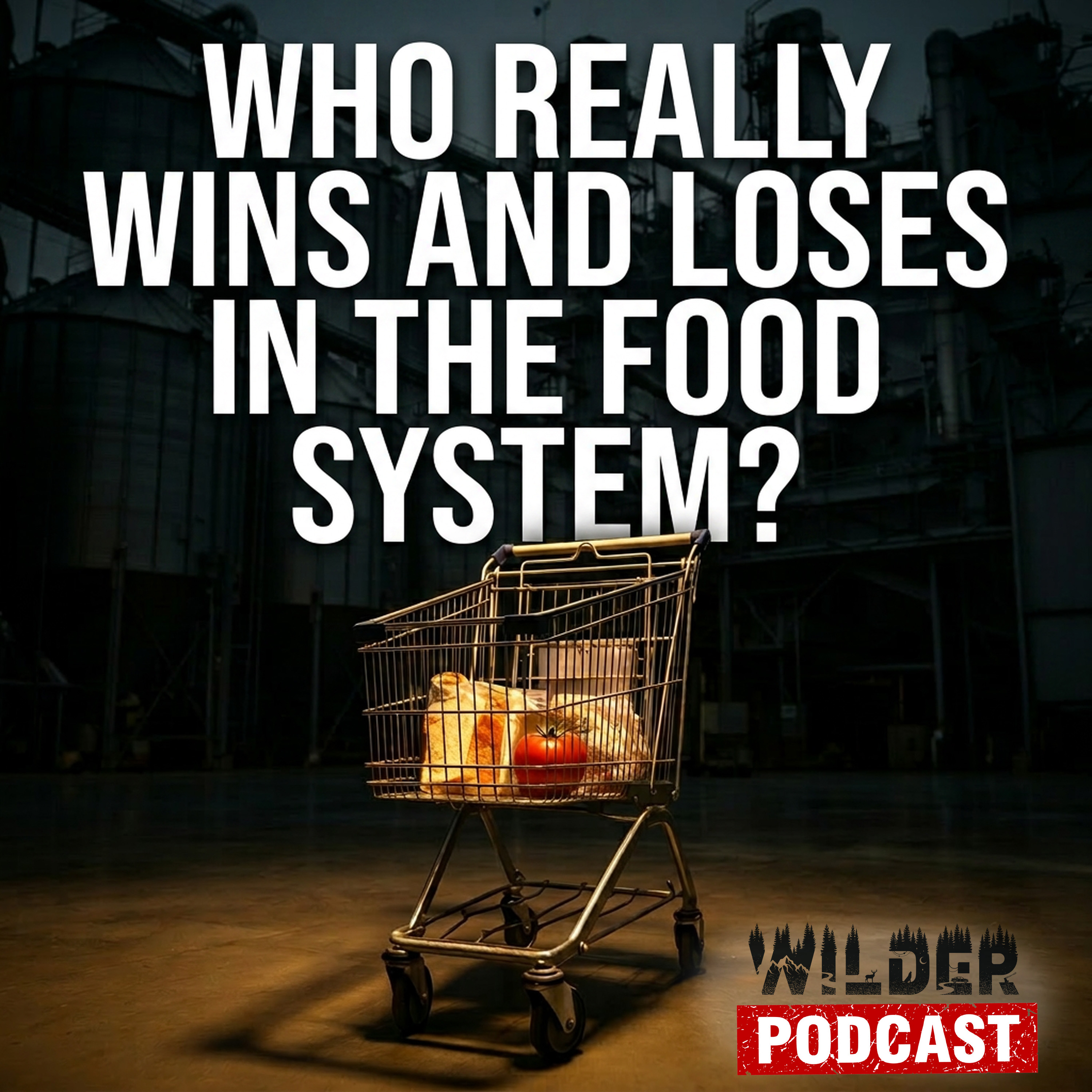
Every time you push a trolley around a UK supermarket, you are playing a game.
The game has winners and losers. The rules were written by people you will never meet, in rooms you will never enter. Most of us did not know there was a game at all.
This is what we find ourselves thinking about after almost three years of trying to grow food on 80 acres in Monmouthshire, and, recently, after a long conversation on the Wilder Podcast with Sue Pritchard, Chief Executive of the Food, Farming and Countryside Commission.
Sue has spent seven years mapping this system for government, for farmers, and for the rest of us. When she lays it out, three things become impossible to un-see.
"Some people will say it's a broken system. I don't like using that phrase, because in my experience, if systems are genuinely broken, then they will find ways of finding a new equilibrium. The fact that the one that we're in at the moment is so hard to change tells me over and over again that that is because it's actually benefiting some very powerful people extremely well."
Sue Pritchard
The winners are not who you think
Ask most people to name the companies that shape what the UK eats, and they will say Nestle, Coca-Cola, Unilever, PepsiCo. The brands on the shelf. The logos we grew up with.
Those companies are real, and they are powerful, but they are not the top of the chain. They are customers of a second layer of companies almost nobody outside the industry has heard of.
They are known as the ABCD: Archer Daniels Midland, Bunge, Cargill and Louis Dreyfus. Four firms, all of them over a century old, all of them quietly dominant. Between them, they control somewhere between 70 and 90 per cent of the global grain trade. They supply the commodity inputs, grain, oilseed, sugar, cotton, that the visible brands then turn into the products we buy. They also supply the seed, the fertiliser, the agrochemicals, and the processing infrastructure to the farmers who grow the crop in the first place. Cargill alone, privately held and therefore exempt from most of the transparency public companies face, made revenues of $165 billion in 2022.
"The global commodity trade is controlled by five major companies. They're often called the ABCD companies: Archers, Bunge, Cargill and Dreyfus. Those four or five companies control well over 80 per cent of the world commodity trade, but not just commodity trade. Cargill, for example, controls seed, it controls farms, it controls meat production, a lot of it in the US and in the Amazon rainforest, and they control the production of chicken sheds in the Wye Valley where you and I live, behind the brand Avara."
Sue Pritchard
You have probably never seen one of their logos. That is by design. The ABCD have spent a hundred years operating upstream of anything a consumer ever touches, and they are extraordinarily good at it.
"Since the Ukraine War, when commodities really started spiking, the rest of us were having to accommodate those rising food prices. Cargill's profits went up 27 per cent. The Cargill family are already one of the richest families in the US: 14 family members, all of them billionaires. It's not even shareholder owned. It's an extraordinarily powerful and indeed opaque company."
Sue Pritchard
Behind both layers sits a third industry almost nobody thinks about. The lobbyists, the marketing firms, the advertising agencies, the PR consultancies. Their job is not to feed you. Their job is to protect the business models of the companies that do.
"Huge beneficiaries of the system are the admin, the marketing folk, the advertising agencies, the lobbyists. That is a multi-billion pound sector as well as the food production sector. And that sector works really, really hard for the companies they work for: for Pepsi, for Nestle, for Coca-Cola, the brands that are familiar to us every day."
Sue Pritchard
The most profitable products across all of it are the ones furthest from food. Sue calls them ultra-processed products, not foods, because they are largely unrecognisable from anything that grew in a field. They are researched, marketed and promoted because they deliver the margins. The vegetables do not.
"Most of these corporations don't particularly care what they sell. What they care about is what profit they can make out of it. That's one of the explanations for the rise in ultra-processed foods. Some of my pals will call them ultra-processed products, not foods, because they're pretty unrecognisable from healthy food now. Those products have been carefully researched, carefully marketed, carefully promoted because they're the most profitable to those food companies."
Sue Pritchard
The losers are nearly everyone else
Farmers are losing. Primary producers in the UK are squeezed on price by the same supermarkets that built their own brands on selling cheap food, and carry the risk when harvests fail, when disease hits, when the weather turns. The average age of a UK farmer is now around sixty. A lot of them are quietly getting out.
"Farmers' real incomes have not improved in real terms in 50 years. At the moment, probably 40 per cent of farmers are earning less than the real living wage and are reliant on government support, because the markets that they're operating in don't pay them the real cost of production."
Sue Pritchard
Citizens are losing. UK households are eating more ultra-processed food than almost any other population in Europe. Obesity, type 2 diabetes, heart disease and a growing body of evidence on the link between ultra-processed diets and mental health are all climbing. The cost of treating what we eat lands in the NHS, which means it lands on all of us.
Taxpayers are losing twice over. Once for the food itself, through a supply chain that only looks cheap because its real costs are pushed somewhere else. Once again through the tax bill, funding the health system, the environmental clean-up, the flood defences, the rural support payments that keep the whole structure standing.
"The people who are losing out in the way that the food system works at the moment are the primary producers and growers and citizens, who are either paying in the cost of their health, or in their baskets, or otherwise they're paying through their taxes in trying to clean up the environmental impacts of a food system that offsets, offshores much of its costs to either other sectors or other parts of the world."
Sue Pritchard
Even people doing everything right are losing. You can shop at a farmers' market every Saturday, buy organic when you can afford it, avoid the ultra-processed aisle entirely. Your taxes still pay for the damage being done everywhere else. There is no opt-out.
Why we do not know this
We spoke to Sue about why this picture is not obvious to everyone.
Part of the answer is structural. The food system is long, complex, and deliberately opaque. Most of its costs are invisible at the till. The price on the shelf is the end of a chain most shoppers never see.
Part of it is more deliberate. The same industry that markets the products also markets the story. Three arguments keep the system in place. People only want cheap food. Nobody wants a nanny state. Healthy eating is a middle-class concern.
"People just care about cheap food. Nobody wants the nanny state. Nobody wants to be told what to eat. Very often they'll say, well, these are just middle-class concerns, these are just the Waitrose shoppers who talk about this kind of thing, poor people don't care about this kind of stuff. And of course, none of that is true."
Sue Pritchard
None of them are true. When Sue's team at FFCC actually asked people what they wanted from food, through 12 citizens' assemblies across the UK, the answers were remarkably consistent and remarkably unremarkable. People want healthy food, fair prices, decent treatment for producers, and a system that is not exporting its costs to other places and other generations.
"Almost universally, people would look at the system as it was revealed to them, and they would first of all be astonished, and then they would be angry. And they would say, why don't we know this? Why don't we know that this is how it works? My response to them is, that's the most important question. Why don't we know?"
Sue Pritchard
That is not a middle-class opinion. That is almost everyone.
What to do with this
We are not going to pretend we have a neat answer. We run an 80-acre rewilding project and a market garden. We are inside this system, not above it.
What we do know is this.
The moment you see the winners clearly, the debate changes. "People just want cheap food" stops sounding like wisdom and starts sounding like cover. The question shifts from what should I buy to who is this set up to benefit, and who decided that.
That is where the next three pieces in this series go.
Listen to the full conversation
This piece draws on our conversation with Sue Pritchard on episode 53 of the Wilder Podcast: 'Who Really Wins and Loses in the Food System'.
Listen on Spotify, Apple Podcasts, or wherever you get your podcasts.
Sue is Chief Executive of the Food, Farming and Countryside Commission and farms in Monmouthshire.
The full series
- Part 1: Who really wins in the UK food system?, you are here
- Part 2: Why shopping can't fix the UK food system (coming soon)
- Part 3: The case for anger (and shame) in UK food policy (coming soon)
- Part 4: What people actually want from food (coming soon)
Visit the Grange Project
The Grange Project is an 80-acre rewilding site in Monmouthshire, restoring former intensive grassland to a mosaic of habitats. We host cabin stays, corporate away days, community days, and courses in growing food in harmony with nature.